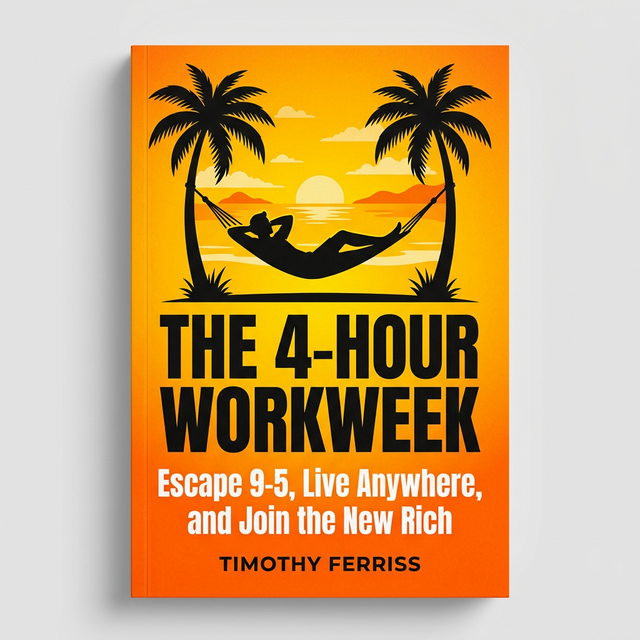
The 4-Hour Workweek Summary
About the Book
Tim Ferriss dismantles the 40-year career and offers the DEAL framework (Definition, Elimination, Automation, Liberation) for designing a life where you work fewer hours on things you love, earn more, and spend your time on adventures and experiences.
Key Lessons
- DEAL: Define > Eliminate > Automate > Liberate
- Parkinson's Law: work expands to fill the time allowed
- The 80/20 rule: 20% of effort produces 80% of results
- Fear-setting: visualise the worst case to overcome paralysis
- Mini-retirements beat the deferred-life plan
Important Quotes
- What we fear doing most is usually what we most need to do.
- Being busy is a form of laziness — lazy thinking and indiscriminate action.
- The timing is never right. For anything important, you must start now.
- Someday is a disease that will take your dreams to the grave with you.
Chapter Summary
D — Definition: Cautions and Comparisons
Define 'the good life' on your own terms. Most people pursue money as an end, not a means — Ferriss reframes the target: not retirement, but excitement and freedom throughout life.
D — Dodging Bullets: Fear-Setting
Fear-setting is more important than goal-setting. Write out the worst-case scenario, the probability, the fix — you'll find the downside is rarely as catastrophic as the paralysis suggests.
D — System Reset: Being Unreasonable
The timing is never right. Waiting for the perfect moment is a form of cowardice in disguise. The question is not whether you can afford to take a risk — it's whether you can afford not to.
E — Elimination: The Art of Selective Ignorance
Information overload is self-imposed. Practice selective ignorance: a low-information diet means reading only what is immediately actionable. What you don't read can't hurt you.
E — The 80/20 Principle and Parkinson's Law
20% of your clients produce 80% of your income — and 80% of your headaches. Cut the bottom 80% and shorten your deadlines; work contracts to fill the time allotted.
A — Automation: Outsourcing Life
Virtual assistants cost $4–$15/hour and can handle email, travel, research, and admin. The goal: remove yourself from the loop for every repetitive task that doesn't require your physical presence.
A — Income Autopilot: Building a Muse
Create a product or service that generates income without your continuous involvement. Test ideas cheaply, validate demand before building, and only invest when the concept is proven.
L — Liberation: Disappearing Act
Most bosses won't fire a valuable remote worker — they'll accept it. Negotiate remote arrangements by proving you are more productive away from the office before officially asking.
L — Mini-Retirements
Take extended travel breaks throughout your working life instead of deferring everything to age 65. A month abroad costs less than you think — and the memories compound like investments.