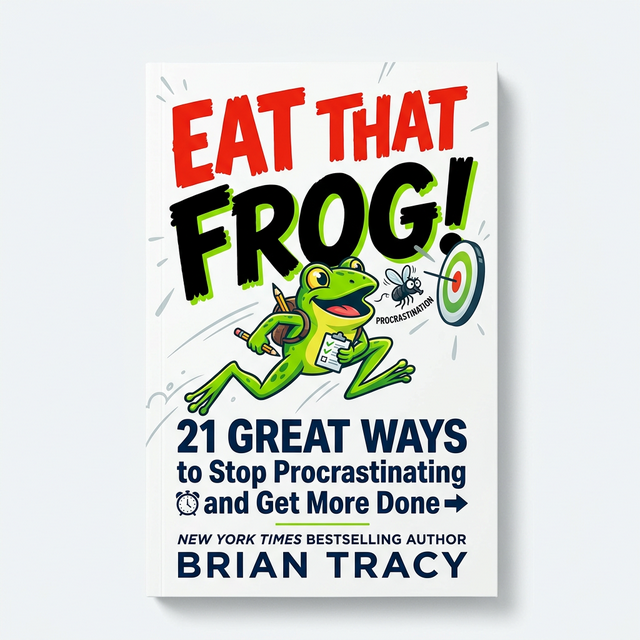
Eat That Frog! Summary
About the Book
Brian Tracy shares 21 practical strategies to stop procrastination and get your most important tasks done first. The 'frog' metaphor: tackle your biggest, most impactful task first thing in the morning when willpower is highest. If you must eat two frogs, eat the ugliest one first.
Key Lessons
- Eat the ugliest frog first — start with your most important task
- ABCDE method: rank tasks by consequence before starting
- Apply the 80/20 rule to your task list every single day
- Prepare everything the night before for a flying morning start
- Upgrade your key skill that unlocks the most results
Important Quotes
- If it's your job to eat a frog, eat it first thing in the morning.
- A major reason for procrastination is that the task seems overwhelming.
- Successful people have the habit of doing the things failures don't like to do.
- Set deadlines for everything important to you.
Chapter Summary
Set the Table
Decide exactly what you want, write it down, and set a clear deadline. Clarity about what you want and why you want it is the most powerful antidote to procrastination and confusion.
Plan Every Day in Advance
Make a list the night before. Organise it. Your subconscious works on it overnight, and you start the morning immediately productive rather than deciding what to do while half-awake.
Apply the 80/20 Rule to Everything
The top 20% of tasks produce 80% of value. Before you eat any frog, ask: is this actually in my top 20%? Resist the temptation to do easy tasks first just because they feel good to cross off.
Consider the Consequences
Long-term thinking is the difference between high achievers and everyone else. Ask: what are the long-term consequences of doing or not doing this task? Action has compounding returns; so does avoidance.
Practice Creative Procrastination
Since you can't do everything, you must procrastinate on something. Deliberately procrastinate on low-value tasks to protect time for high-value ones. Procrastinate with intention.
Use the ABCDE Method
A — must do (serious consequences), B — should do, C — nice to do, D — delegate, E — eliminate. Never do a B task when an A task is undone, no matter how tempting the B feels.
Focus on Key Result Areas
Identify the 5–7 results you are paid to produce. Which skills, if improved, would most dramatically increase your output? The weakest key result area sets the ceiling for all your results.
Upgrade Your Key Skills
The better you are at your most important task, the faster and easier it is to finish. Invest in the specific skill that, if doubled, would most increase your effectiveness.