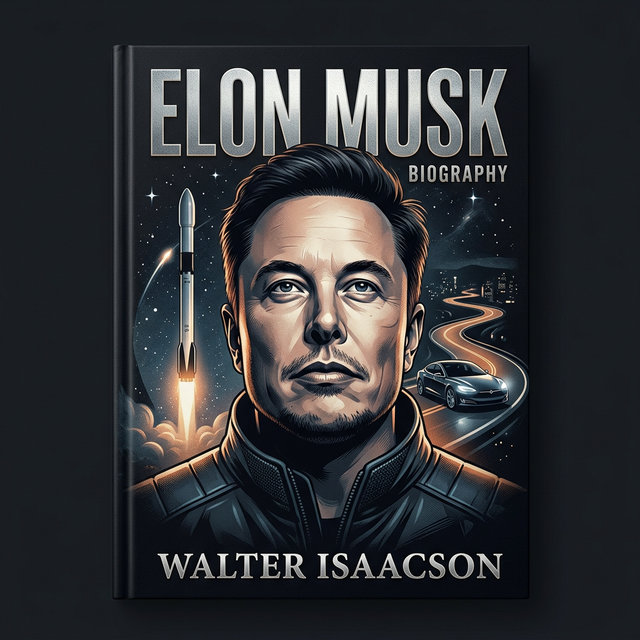
Elon Musk Summary
About the Book
Walter Isaacson spent two years shadowing Elon Musk and interviewed hundreds of people in his orbit. The result: an unflinching portrait of a man driven by a demon — fear of humanity's extinction. Musk's companies (Tesla, SpaceX, Neuralink, X) are all bets on a multi-planetary, sustainable civilisation.
Key Lessons
- Musk's driving force: genuine fear that humanity will go extinct
- The 'idiot index': reject requirements that add cost without reason
- Algorithm: question requirements → delete → simplify → accelerate → automate
- Surges: Musk injects himself into crises personally to force breakthroughs
- Hardcore management style polarises — but delivers results few thought possible
Important Quotes
- I would like to die on Mars. Just not on impact.
- If something is important enough, even if the odds are against you, you should still do it.
- When something is important enough, you do it even if the odds are not in your favor.
- I'm allergic to the word 'impossible'.
Chapter Summary
Demons: A Childhood in South Africa
Musk's difficult childhood — a cold, demanding father and relentless bullying — hardened him into someone who can emotionally detach from pain to concentrate on mission. The wound became the engine.
Canada and College: The Making of a Technologist
Musk taught himself computer programming, chose physics and economics at Penn, and developed his first great insight: the internet, clean energy, and space would be the most transformative industries of the next century.
Zip2 and X.com: The First Fortunes
Musk built and sold Zip2 (a maps startup) for $307 million, then founded X.com (later PayPal), which was sold to eBay for $1.5 billion. He invested nearly every dollar into his next bets: rockets and electric cars.
SpaceX: The Rocket Company
Three consecutive rocket failures nearly destroyed SpaceX. Musk bet everything on a fourth launch — which succeeded. The company then won a NASA contract that saved it. The near-death experience forged SpaceX's relentless culture.
Tesla: The Electric Car Bet
Conventional wisdom said electric cars couldn't be compelling, profitable, or produced at scale. Tesla proved all three wrong. Musk personally took over production during crises, sleeping on the factory floor until things worked.
The Algorithm and the 'Idiot Index'
Musk's five-step engineering algorithm: question every requirement, delete everything unnecessary, simplify, accelerate, and only then automate. The 'idiot index' — the ratio of part cost to raw material cost — flags over-engineered waste.
Twitter / X: The Turbulent Takeover
Musk bought Twitter for $44 billion impulsively, then laid off 80% of staff, slept at the office, and made constant chaotic decisions. A case study in what happens when a force-of-nature operator runs a social media company.