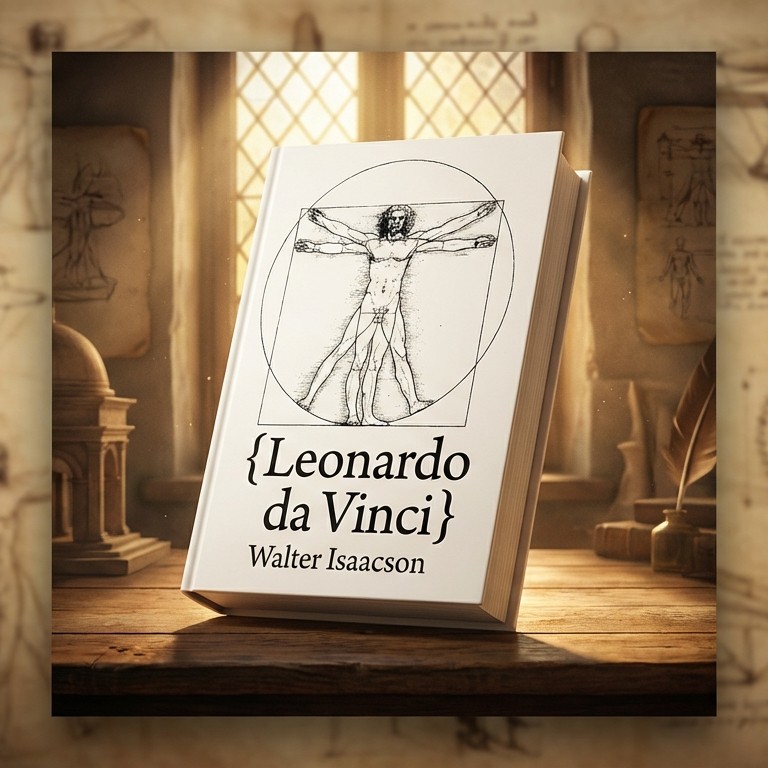
Leonardo da Vinci Summary
About the Book
Drawing on Leonardo's thousands of pages of notebooks, Isaacson reveals how curiosity — not genius — was the one quality that made Leonardo exceptional. He was illegitimate, had almost no formal education, and frequently left projects unfinished. But his relentless curiosity led to discoveries that were centuries ahead of their time.
Key Lessons
- Curiosity is a skill, not a trait — it can be cultivated and practised
- Leonardo's notebooks show science and art as one unified inquiry
- He studied the unrelated obsessively — and found connections others missed
- Perfectionism delayed masterpieces — but the study surpassed the painting
- Observe, question, connect — the three habits of a genius mind
Important Quotes
- Learning never exhausts the mind.
- Simplicity is the ultimate sophistication.
- I have been impressed with the urgency of doing. Knowing is not enough; we must apply.
- Art is the queen of all sciences communicating knowledge to all the generations of the world.
Chapter Summary
Childhood: The Bastard Who Observed Everything
Illegitimate and largely self-taught, Leonardo observed nature with an intensity that no classroom could have provided. His notebooks from childhood show a mind already asking questions that no one else thought to ask.
Florence and the Medici Workshop
Apprenticed to Verrocchio, Leonardo absorbed painting, sculpture, and engineering simultaneously. He was already surpassing his master by 20. Florence was the greatest concentration of creative genius the world had ever seen.
Milan: Engineer and Entertainer
At the Sforza court in Milan, Leonardo designed weapons, planned canals, painted the Last Supper, and staged elaborate theatrical productions. His energy was unlimited; his ability to switch between disciplines was unparalleled.
Anatomy: The Body as a Machine
Leonardo dissected over 30 human corpses to understand musculature and movement. His anatomical drawings were 300 years ahead of published medical science. He saw the body as an engineering problem to be solved.
The Mona Lisa and the Obsession with Perfection
Leonardo worked on the Mona Lisa for 16 years and never considered it finished. He studied how light plays on curved surfaces, painted layer upon translucent layer, and achieved a depth and softness no previous painter had managed.
Science, Birds, and the Dream of Flight
Leonardo studied birds obsessively and designed ornithopters and gliders in 1490 — 400 years before the Wright brothers. He understood the physics of lift and drag through observation alone, before the mathematics existed to describe them.
The Final Years and the Unfinished Projects
Leonardo left dozens of great projects incomplete. His notebooks were never organised or published. Yet what he did complete — and what he explored in private — remains the greatest single body of genius the world has ever seen.