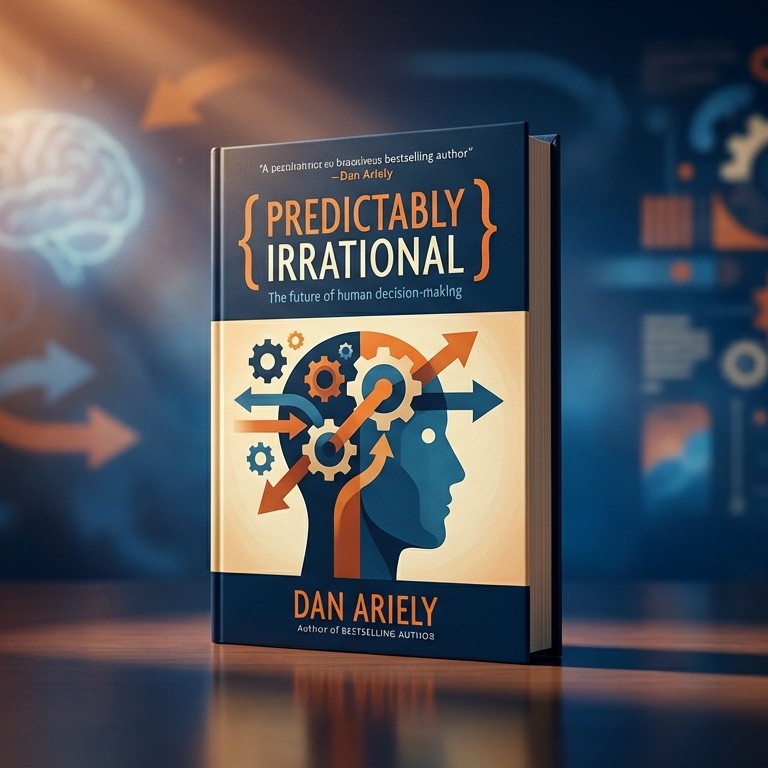
Predictably Irrational Summary
About the Book
MIT professor Dan Ariely reveals through experiments that our irrational behaviours are not random — they are systematic and predictable. From why 'free' is more powerful than cheap, to why ownership inflates our valuation, to how expectations change actual experience — these forces shape every decision we make.
Key Lessons
- Everything is evaluated in relative terms — anchoring shapes all prices
- 'FREE' triggers an irrational emotional response that overrides logic
- The endowment effect: we overvalue what we own
- Social norms and market norms don't mix — money ruins the pleasant
- Expectations change actual experience (placebo applies everywhere)
Important Quotes
- Humans rarely choose things in absolute terms. We focus on the relative advantage of one thing over another.
- The truth is, small and seemingly insignificant nudges can have a large impact on our behavior.
- Once we touch something, we have an endowment relationship with it.
- We are not only irrational, but predictably irrational — our irrationality happens the same way, again and again.
Chapter Summary
The Truth About Relativity
We never evaluate anything in isolation — always in comparison. A $30 pen feels cheap next to a $60 pen and expensive next to a $10 pen. Context shapes every perception of price, quality, and value.
The Fallacy of Supply and Demand
Prices are not determined by the laws of supply and demand — they are anchored by the first price we see. This 'arbitrary coherence' stays with us and shapes every subsequent financial decision we make.
The Cost of Zero Cost
'FREE' is not just a price — it is an emotion. Zero cost removes all perceived risk, even when the free option is clearly inferior. This is why lines form for free ice cream samples that aren't worth queuing for.
The Cost of Social Norms
Social norms and market norms operate on different psychological frameworks. Introducing money into a relationship governed by social norms immediately converts it to a market relationship — and the social warmth evaporates.
The Influence of Arousal
Decision-making in a cold, rational state versus in an emotionally aroused state produces vastly different choices. We systematically underestimate how different we will be in hot states — which causes overconfident predictions about our future behaviour.
The Problem of Procrastination and Self-Control
We consistently prefer present pleasure over future benefit. Commitment devices — removing future choices, creating penalties for failure — are the most effective way to overcome predictable self-control failure.
The Power of Price
A more expensive placebo relieves more pain than a cheap one. Our expectations — shaped by price, brand, and presentation — cause neurological changes that alter actual experience. Expectation is not just psychology; it is physiology.