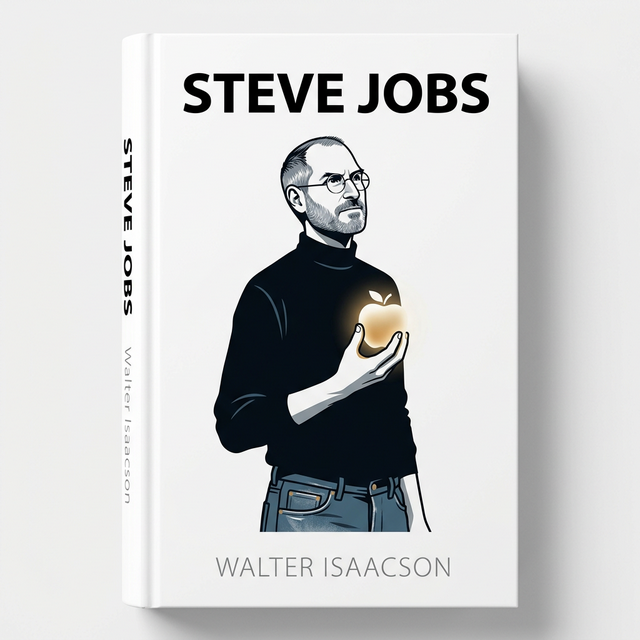
Steve Jobs Summary
About the Book
Based on over 40 interviews with Jobs and hundreds with family, friends, and rivals, this is an honest portrait of a creative genius whose passionate perfectionism drove him to build Apple and Pixar — while his interpersonal flaws drove people away. Jobs believed people didn't know what they wanted until he showed them.
Key Lessons
- Reality distortion field: his belief that normal rules didn't apply to him
- Simplicity is the ultimate sophistication — remove everything non-essential
- A-players only: mediocrity is a virus that infects the whole team
- Products at the intersection of tech and humanities — the liberal arts matter
- The journey is the reward — work for love, not money
Important Quotes
- Your time is limited, so don't waste it living someone else's life.
- Stay hungry, stay foolish.
- Creativity is just connecting things.
- Design is not just what it looks like and feels like. Design is how it works.
Chapter Summary
Childhood, Adoption, and Reed College
Jobs was adopted at birth and always felt 'chosen'. Reed College exposed him to calligraphy, which directly shaped the Mac's beautiful typography. He dropped out after one semester but audited courses for 18 months.
Atari and India: The Seeker
Jobs worked at Atari and travelled to India seeking spiritual awakening. He returned more focused and intense. The blend of Eastern philosophy and Western technology became his defining worldview.
Apple I and II: The Garage
Wozniak built the computer; Jobs envisioned the product and the company. The Apple II generated $139 million in its first three years. Jobs learned that great engineering needs great packaging to change the world.
The Macintosh: Thinking Different
Jobs drove the Mac team with a reality distortion field — convincing engineers to do things they believed impossible. The 1984 Super Bowl ad launched not just a product but a brand mythology that persists today.
Exile and NeXT and Pixar
Fired from Apple in 1985, Jobs founded NeXT (which failed commercially but built the OS that became macOS) and invested in Pixar. Toy Story made Pixar a phenomenon and Jobs a billionaire — before his return to Apple.
The Second Coming: iMac, iPod, iTunes
Returning to Apple in 1997, Jobs cut 70% of products and focused obsessively on four. The iMac, iPod, and iTunes created the digital music revolution and restored Apple's sense of identity and momentum.
iPhone and iPad: The Post-PC Era
Jobs called the iPhone 'an iPod, a phone, and an internet communicator' — the most revolutionary product launch since the Mac. The App Store created a new economy. The iPad redefined computing for millions.
The End and the Legacy
Jobs died in October 2011. His greatest legacy was proving that technology and the humanities are not separate disciplines — that the most powerful products live at their intersection.