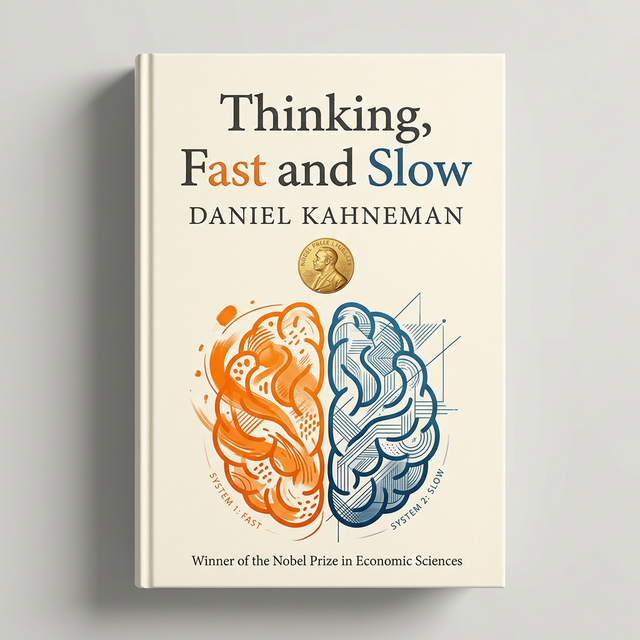
Thinking, Fast and Slow Summary
About the Book
Nobel laureate Daniel Kahneman reveals two systems of thinking: System 1 (fast, intuitive, emotional) and System 2 (slow, deliberate, logical). Our brains default to the effortless System 1, leading to systematic cognitive biases and errors. Understanding these biases is the first step to better decisions.
Key Lessons
- System 1 is fast and automatic; System 2 is slow and deliberate
- Cognitive biases are systematic, predictable errors in thinking
- Anchoring: the first number you see disproportionately shapes all judgements
- Loss aversion: losses hurt twice as much as equivalent gains feel good
- Experiencing self vs remembering self — we evaluate experiences wrongly
Important Quotes
- Nothing in life is as important as you think it is when you are thinking about it.
- A reliable way to make people believe in falsehoods is frequent repetition, because familiarity is not easily distinguished from truth.
- We are generally overconfident in our opinions and our impressions.
- The confidence people have in their beliefs is not a measure of the quality of evidence.
Chapter Summary
Two Systems
System 1 is automatic, fast, and emotional — it runs constantly without effort. System 2 is slow, deliberate, and effortful — it kicks in only when System 1 flags a problem. Most decisions are System 1, for better and worse.
Attention and Effort
System 2 has a limited budget of attention. When it's busy or depleted, System 1 takes over — leading to more errors and more susceptibility to cognitive biases. Tired minds make worse decisions.
The Lazy Controller
Most people avoid the cognitive effort of System 2 thinking whenever possible. This cognitive ease leads us to prefer familiar-sounding things, believe repeated claims more readily, and choose the path of least mental resistance.
The Associative Machine
System 1 works by association — priming one idea automatically activates related ideas. Even irrelevant environmental cues shape our behaviour and judgements without our awareness.
Heuristics and Biases
When uncertain, System 1 substitutes a hard question for an easier one. The availability heuristic, the representativeness heuristic, and the affect heuristic all create systematic, predictable errors.
Anchoring
Any number you encounter — even a random one — influences all subsequent estimates and judgements. Negotiators, estate agents, and salespeople all exploit anchoring systematically and powerfully.
Overconfidence
We are all overconfident about things we know, plans we make, and futures we predict. The planning fallacy — underestimating time and cost, overestimating benefit — is universal and extremely costly.
Choices and Prospect Theory
We do not evaluate outcomes in absolute terms but relative to a reference point. Losses loom roughly twice as large as equivalent gains — this asymmetry drives most of the puzzling features of economic behaviour.
Two Selves
The experiencing self lives in the present moment. The remembering self constructs and stores narratives about past experiences. These two selves have different interests — and the remembering self almost always wins.