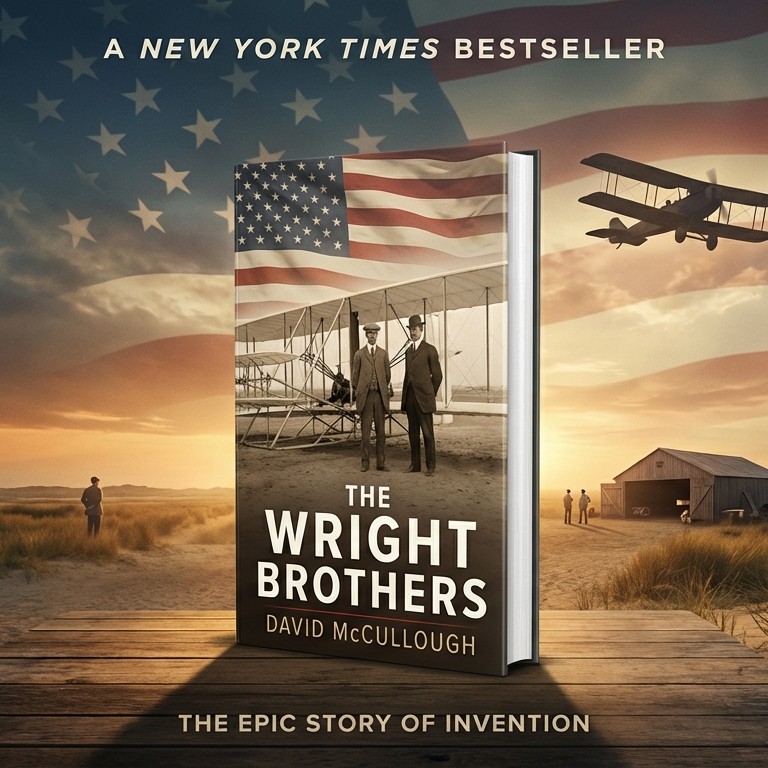
The Wright Brothers Summary
About the Book
Pulitzer Prize winner David McCullough tells the story of Wilbur and Orville Wright — two self-taught bicycle mechanics from Dayton, Ohio, who solved the problem of powered flight in four years of methodical, scientific work. With no formal training, no government funding, and no investors, they changed every life on Earth.
Key Lessons
- Self-education and relentless practice beat formal credentials
- Systematic iteration: test → fail → learn → repeat, until you fly
- Wilbur and Orville complemented each other perfectly — argument was their method
- No investor, no university, no government — just resourcefulness and grit
- Persistence through ridicule and failure was their true invention
Important Quotes
- If birds can glide for long periods of time, then... why can't I?
- It is possible to fly without motors, but not without knowledge and skill.
- The desire to fly is an idea handed down to us by our ancestors who looked enviously on the birds.
- Success comes from taking the initiative and following up.
Chapter Summary
Young Men of Dayton
Wilbur and Orville Wright are bookish, methodical, and inseparably close. Running a bicycle shop gives them mechanical skill, engineering intuition, and enough income to fund their real obsession: flight.
The Problem of Control
Where other flight pioneers focused on engine power, the Wrights realised control was the unsolved problem. Wilbur's insight — that wing-warping could steer an aircraft like a bird tilts its wingtips — was the breakthrough.
Kitty Hawk: The First Tests
The desolate dunes of North Carolina provided steady winds and soft landing ground. Three years of glider experiments taught the brothers what no textbook could: how air actually behaves across a curved wing surface.
December 17, 1903
Twelve seconds. One hundred and twenty feet. Four flights that day. The world's first powered, controlled, sustained flight — witnessed by five people, reported by almost no one. It didn't matter: it had happened.
The World Catches Up
For two years after their success, almost no one believed them. The press ignored them; governments dismissed them. The Wrights quietly improved their design while the world slowly caught up to the reality of what had occurred.
Europe and the International Sensation
Wilbur's 1908 demonstrations in France — graceful, controlled, impossible — electrified Europe. Kings, presidents, and hundreds of thousands saw him fly. Overnight, the century of aviation had begun.